RESEARCH / Robotics
Bring learning into physical motion.
Sensing, deciding and moving form a continuous problem. Study both adaptive control and the constraints imposed by a body, beyond learning or geometry alone.
Research question
How can learned control hold up in a world with a body?
Design stance
An intelligent output is not enough to move a machine. Observation delay, body structure and joint constraints change the available actions. Study adaptive control and mechanical feasibility together, with an explicit boundary between learning and deterministic output.
Research themes and projects
Lines connect research themes to the projects exploring them. Select a project to read more.
- Learning and controlCore · Reflex · MotorNerve
- Body and motionKinematics · Multibody dynamics
Technical investigations
Adaptive control / Core / Reflex
manas explores CNS-style control through Core and Reflex. Learning belongs there; MotorNerve provides morphology-dependent deterministic output. Swift owns typed control and lifetime, while Mojo owns numerical computation.
Read the primary design
manas · README.md ↗Kinematics / Multibody dynamics
swift-mechanics declares bodies, joints and constraints, then evaluates motion and forces for admitted models. Declaration nesting is not the physical connection graph. This foundation examines the gap between requested movement and what a mechanism permits.
Read the primary design
swift-mechanics · README.md ↗
The research thread
manas explores adaptive control from sensing through Core, Reflex and MotorNerve. swift-mechanics studies motion and forces through bodies, joints and constraints. These are complementary research directions; hardware deployment and safety qualification need their own evidence.
RESEARCH / Robotics
Projects in this field
Open a project to explore its purpose, design choices and architecture.
The animated visual could not be displayed.
ROBOTICS / ADAPTIVE CONTROL01
manasBring learning into a moving world.
From sensing to action. Explore how learning Core and Reflex components can feed deterministic motor output.
Swift · Mojo · Robotics · Adaptive control
Explore the system
The animated visual could not be displayed.
Bring learning into a moving world.
From sensing to action. Explore how learning Core and Reflex components can feed deterministic motor output.
Swift · Mojo · Robotics · Adaptive controlBring learning into a moving world.
From sensing to action. Explore how learning Core and Reflex components can feed deterministic motor output.
Room to learn. A defined boundary for action.
Manas researches adaptive robotics control through a CNS-style (central nervous system) protocol. Learning lives in Core and Reflex; MotorNerve remains a deterministic, morphology-dependent output path. Swift owns intent and lifecycle, Mojo numerical computation. Learning capability and physical deployment are separate questions, with HIL (hardware-in-the-loop) and target qualification as distinct gates.
Read the source · README.md ↗Behind the experience
Select a node to read its role.
Bundle sensory input contracts
- NerveBundle→Gating / TrunksData / execution
- Gating / Trunks→Core / ReflexData / execution
- Core / Reflex→MotorNerveData / execution
- Core / Reflex→Mojo runtimeUses / depends on
- MotorNerve→Plant / WorldData / execution
- Plant / World→NerveBundleResult / response
NerveBundle passes through Gating and Trunks to Core/Reflex, MotorNerve and Plant. Swift owns intent and lifecycle; Mojo owns numerical work.
Study behavior through a machine’s relationship with its environment.
Sensing leads to action, whose result is sensed again. Studying this loop through learning and motor control aims to support the design of machines that respond to their environment.
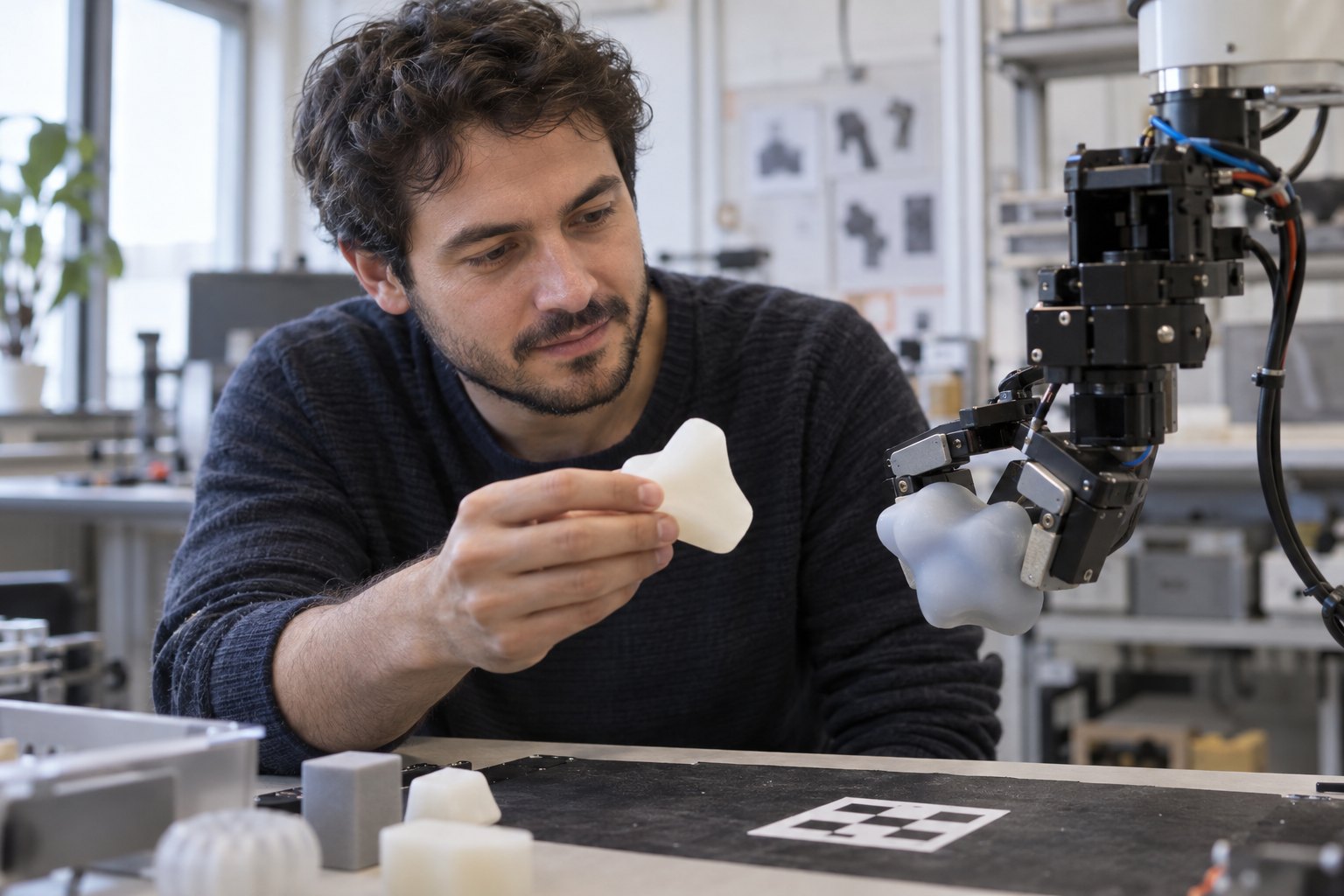
The image could not load. The experience is described below.
An AI-generated imagined use scenario, not an actual customer or product screen.
The animated visual could not be displayed.
KINEMATICS / DYNAMICS02
swift-mechanicsAfter shape comes motion.
Read motion and forces from relationships between bodies and joints. Grow a runtime for exploring mechanisms.
Swift · Kinematics · Multibody dynamics
Explore the system
The animated visual could not be displayed.
After shape comes motion.
Read motion and forces from relationships between bodies and joints. Grow a runtime for exploring mechanisms.
Swift · Kinematics · Multibody dynamicsAfter shape comes motion.
Read motion and forces from relationships between bodies and joints. Grow a runtime for exploring mechanisms.
A mechanism must become an admissible model.
In kinematics and multibody dynamics, a part hierarchy differs from the graph that transmits forces. Rigid bodies, joints, constraints and force laws have distinct meanings; units and connections are checked during compilation before reaching the runtime model. Constructing a declaration is separate from admitting a physical analysis model. Higher-level notation and analysis coverage still include development targets.
Read the source · README.md ↗Behind the experience
Select a node to read its role.
Record relationships of bodies and joints
- Body / Joint→Bounded loweringData / execution
- Bounded lowering→CompiledModelData / execution
- CompiledModel→Runtime evolutionData / execution
- Runtime evolution→Analysis appData / execution
Body and Joint records pass through bounded lowering into a compiled model and runtime evolution. Motion and diagnostics are separate from geometry.
Judge a mechanism by how it moves.
After defining a shape, consider how forces travel and parts move together. This runtime is being developed so mechanism choices can be explored through their motion and force behavior.

The image could not load. The experience is described below.
An AI-generated imagined use scenario, not an actual customer or product screen.